
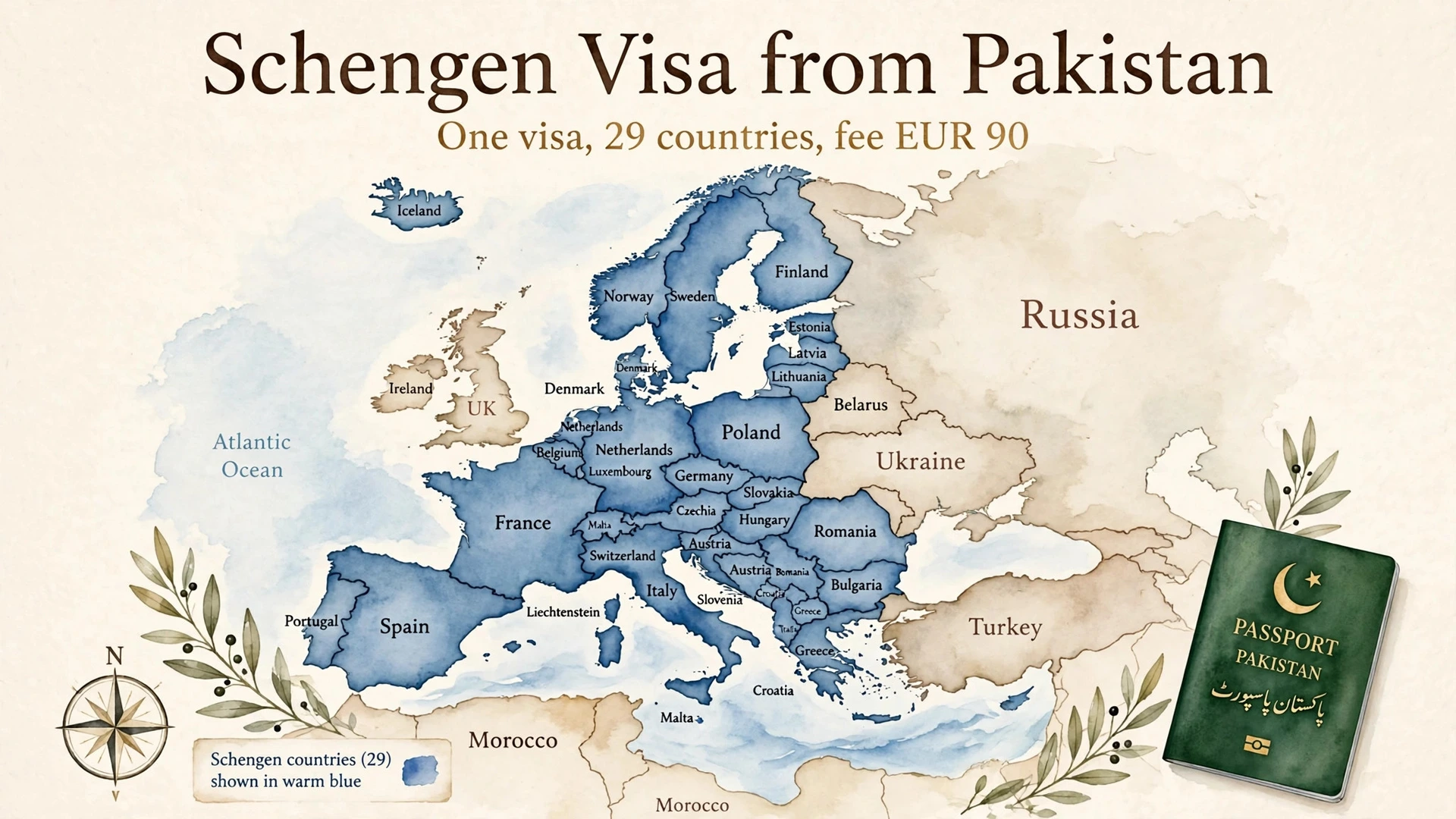
Schengen Visa from Pakistan 2026: Fees, Requirements and How to Apply
Quick answer: A Pakistani citizen needs a Schengen short stay visa (type C) for the Schengen area, and one visa covers all 29 countries for up to 90 days in any 180 day period. The fee is EUR 90 for adults, EUR 45 for children aged 6 to under 12, and free under 6. You apply to the country where you will spend the most nights, filing through that country’s own Pakistan route (table below). Insurance must cover at least EUR 30,000. Decisions take 15 calendar days by law and can stretch to 45. Checked against European Commission and embassy sources on 11 November 2026.
Schengen questions reach us in two forms. Some travellers have one country in mind and need that country’s rules; this site carries a full guide for each popular one. Others are planning a trip across three or four countries and first need the shared system explained: which country decides, what the visa allows, what it costs in rupees, and where the file goes. This page is that second answer: the rules all 29 countries share, with a pointer to the right country guide wherever they differ.
Read older pages with care: anything quoting a fee of EUR 80, or saying the visa covers 27 countries, works from rules that changed in 2024 and 2025.
Schengen visa at a glance
| Item | Detail |
|---|---|
| Visa type | Schengen short stay, type C (tourism, family visit, business, transit) |
| Countries covered | 29 Schengen states |
| Stay allowed | Up to 90 days in any 180 day period across all 29 states |
| Adult fee | EUR 90 (rupee amount set by each mission) |
| Child fee | EUR 45 (age 6 to under 12); free under 6 |
| Insurance | Minimum EUR 30,000, valid in all Schengen states |
| Processing | 15 calendar days, up to 45 in individual cases |
| Work allowed | No (work needs a national long stay visa) |
What a Schengen visa is, and what it is not
A Schengen visa is a short stay permit issued by one Schengen state and recognised by all of them. It comes as a single, double or multiple entry visa; the sticker states which you hold, its validity dates and day allowance. Most first time applicants from Pakistan receive a single entry visa matched closely to the itinerary. Longer and multiple entry visas follow a record of trips used properly, under a ladder explained below.
Four limits matter as much as the permission itself:
- It is not a work permit. A type C visa covers tourism, visiting family and friends, business meetings, conferences, medical treatment and short courses. Paid work needs a national long stay (type D) visa from the specific country, normally built on a work permit your employer obtains first. Anyone selling a “Schengen work visa” without an employer and a permit behind it is selling a fiction.
- There is no visa on arrival and no free route. Pakistan is on the EU list of countries whose citizens need a visa before travelling. Airlines will not board you without the sticker.
- ETIAS is not your system. ETIAS is being built for travellers who do not need a visa at all. It does not apply to Pakistani passport holders, is not yet in operation, and no agent can register you for it.
- Changing planes can need a visa too. Pakistani passport holders are on the EU list of nationals who need an airport transit visa just to pass through a Schengen airport’s transit area, unless they hold a valid visa or residence permit for a Schengen state, the United Kingdom, the United States or Canada. Check your routing before booking a connection through Frankfurt, Paris or Amsterdam.
The 29 countries, and the ones people get wrong
One visa covers the whole Schengen area: Austria, Belgium, Bulgaria, Croatia, Czechia, Denmark, Estonia, Finland, France, Germany, Greece, Hungary, Italy, Latvia, Lithuania, Luxembourg, Malta, the Netherlands, Poland, Portugal, Romania, Slovakia, Slovenia, Spain and Sweden. That is 25 European Union members; the remaining four, Iceland, Liechtenstein, Norway and Switzerland, are not in the EU at all.
Bulgaria and Romania are the newest full members. They have issued Schengen visas since 31 March 2024 and the last internal land border checks ended on 1 January 2025, so both belong on the list in full, whatever older pages say. The country guides sit in this site’s visa guide index.
Four neighbours cause constant confusion:
- Cyprus is an EU member but not yet inside the Schengen area, so a Schengen visa does not cover it; Cyprus runs its own visa and has its own guide on this site.
- Ireland has an opt out from Schengen and runs its own visa policy. A Schengen visa does not cover Ireland, and an Irish visa does not cover Schengen.
- The United Kingdom is outside both systems and needs its own visitor visa.
- Albania is not a Schengen country and not an EU member; a Schengen visa does not cover it.
Where to apply: the main destination rule
One country examines your file and issues the visa, and the Visa Code fixes which one. Apply to the country where you will spend the most nights. If your nights are split equally between two or more countries, apply to the one you enter first. Count real nights from your bookings, not the country you like most or the one an agent calls easy. Spend seven nights in France, four in Italy and three in Spain, and France decides your case, even if your flight home leaves from Madrid.
Two more rules sit behind that one. You apply in the country where you legally live, so a Pakistani resident files in Pakistan, and some missions split Pakistan by province: the German Embassy in Islamabad and the Consulate General in Karachi each take their own districts, and Italy splits its files the same way.
Applying to the wrong country is not a technicality. Consulates can refuse a file whose bookings point to a different main destination, and the practice, known as visa shopping, damages later applications as well. Build the itinerary first, count the nights honestly, and let the arithmetic choose the consulate. If plans genuinely change after issue, travel on the new plan but keep evidence the change was real: border officers can ask why your story differs from your application.
Where you actually file in Pakistan
There is no single Schengen counter in Pakistan: each country contracts its own intake, and the operators changed during 2026, which is why so many older guides name the wrong company. Position checked on 11 November 2026.
| Main destination | Where and how you file |
|---|---|
| Italy | BLS Intiana centres in Islamabad, Lahore, Karachi and Quetta, booked on the Intiana portal |
| Spain | Intiana centres in Islamabad, Lahore and Karachi, booked at thespainvisa.com |
| France | Form on France Visas, appointment through AEG, interview and biometrics in person at the French Embassy in Islamabad |
| Germany | Direct at the German missions: register free on the online waiting list (Islamabad embassy or Karachi consulate); appointments follow in order |
| Netherlands | VFS Global centres in Islamabad, Lahore and Karachi |
| Portugal | Gerry’s centres; the appointment is requested from the Embassy of Portugal by email first |
| Greece | GVCW centres in Islamabad and Lahore, booked on the GVCW portal (operator since June 2026) |
| Belgium | Form on VisaOnWeb, then the VFS Global and Gerry’s centres |
| Switzerland | VFS Global centres; the Embassy of Switzerland in Islamabad decides |
| Austria, Norway, Denmark, Hungary | VFS Global centres; Norway needs UDI portal registration first, Denmark the form and fee in ApplyVisa first |
| Sweden | VFS Global centre in Islamabad only; Lahore and Karachi do not take Swedish files |
| Poland | Register on e-Konsulat, then apply in person at the Embassy of Poland in Islamabad |
| Romania | Appointment booked on the evisa portal, then in person at the Embassy of Romania in Islamabad |
| Bulgaria | In person at the Embassy of Bulgaria in Islamabad, by appointment |
Most smaller states have no mission of their own in Pakistan, so a bigger neighbour represents them, officially, and applies the destination’s rules:
| If your main destination is | Your file is handled by |
|---|---|
| Finland | The Netherlands desks at VFS Global |
| Iceland | Denmark: decided by the Danish Embassy, filed at the VFS Global centres |
| Estonia or Lithuania | Hungary: decided by the Embassy of Hungary in Islamabad, appointments via the Hungary booking route |
| Latvia or Slovenia | Germany: the German missions, through the same waiting list as German files |
| Luxembourg | Belgium: VisaOnWeb form, then the VFS Global and Gerry’s centres |
| Malta | Italy: the Intiana centres |
| Slovakia | Czechia: the Embassy of Czechia in Islamabad |
| Liechtenstein | Switzerland: the VFS Global centres |
Romania has one extra step: most Pakistani applicants first need an invitation approved by Romania’s General Inspectorate for Immigration, and only then book the embassy appointment.
Operators do change, as Greece showed in June 2026, so confirm the route on your destination’s official page before booking. And hold on to the rule that protects your money at every counter: appointments are booked only through the official portal, and nobody outside it can sell you a slot.
The fee: EUR 90, and what it becomes in rupees
The euro fee is set in the Visa Code and is identical at every consulate: EUR 90 for an adult, EUR 45 for a child aged 6 to under 12, and nothing for a child under 6. The fee is waived for some categories, including family members of EU citizens travelling under the free movement rules. Any website or agent quoting a different euro fee (EUR 80 is the common stale one) is working from before 11 June 2024, when the fee last changed.
In Pakistan you pay in rupees, and here the numbers vary. Each mission converts EUR 90 at its own official rate, revised on its own schedule, so the amount differs slightly by embassy and by quarter. Italy’s embassy rate set EUR 90 at PKR 29,240 for the July to September 2026 quarter, a figure published on its own fee page. The other missions’ published conversions in November 2026 put the same EUR 90 roughly between PKR 28,000 and PKR 31,000. Romania is the exception in form only: its Islamabad embassy quotes USD 105 on its own site, the dollar equivalent of the same EUR 90.
Where a visa centre takes your file, its service charge comes on top. Italy’s centre website states PKR 10,196 and Spain’s Intiana portal PKR 5,554, both checked in November 2026 and both liable to change. Work on about PKR 35,000 to PKR 42,000 per adult, all in, and confirm the amounts on your destination’s portal on the day you book.
One rule has no exceptions: the fee is not refunded on a refusal, and is paid again in full on any new application. That is the financial reason the refusal section below matters.
Documents: the shared core
The Visa Code sets one core file for every application, and the EU has a harmonised document list for applications lodged in Pakistan. Each consulate adds its own extras, and its own checklist, not any general list including this one, governs your file. The core:
- Passport. Machine readable, at least two blank pages, valid for at least three months beyond the date you leave the Schengen area, and issued within the last ten years. Previous passports help if they carry earlier visas.
- Application form. Completed and signed. Most countries now take it online: France Visas for France, the Videx form for Germany, VisaOnWeb for Belgium, ApplyVisa for Denmark.
- Photographs. ICAO standard, taken within the last six months. Most consulates ask for two; a few ask for one.
- Travel medical insurance. Minimum cover EUR 30,000, valid in every Schengen state for the whole stay, covering emergency care, hospital treatment and repatriation, including if the insured person dies. A legal requirement, and policies are checked.
- Purpose and bookings. Confirmed hotel bookings or a host’s invitation and proof of their status, plus a flight reservation. Keep arrangements flexible or refundable until the visa is in hand; several consulates check bookings are still live at decision time.
- Money. Bank statements (six months is the normal expectation in Pakistan) with the bank’s confirmation letter, plus salary slips or business documents explaining where the money comes from.
- Ties to Pakistan. An employer letter stating your role, salary and approved leave, or business registration and tax records if you are self employed; evidence of family and property where relevant.
- Civil documents. A NADRA Family Registration Certificate in English is a standard Pakistan requirement, and married applicants add their marriage certificate.
- Cover letter. A short letter in your own words: who you are, where you are going, the dates, who pays, and why you will return.
Two Pakistan specific notes belong here. Several consulates’ Pakistan checklists, Italy and Romania among them, ask for an international polio vaccination certificate, because Pakistan remains polio endemic; carry it. Expect the small print to differ: Switzerland asks for three months of bank statements where most ask for six, Italy requires NADRA documents to carry an apostille where most accept a certified English translation, and photo counts vary. The full checklist for each country sits in that country’s guide on this site, linked from the routes table above.
How much money should you show?
There is no single Schengen bank balance, whatever the roundup pages claim. The Visa Code asks whether you can pay for the trip and support yourself during it, and each member state sets its own reference amounts for a day of stay, published in its own guidance; Italy’s finance table and France’s official figures both appear in the Italy and France guides on this site. Treat any page quoting one universal daily figure for all 29 countries as unreliable.
What a consulate weighs is coherence: income arriving regularly at the level your job or business would produce, a balance covering the itinerary’s real cost with room to spare, and no large unexplained deposit landed just before applying. Money locked in fixed deposits or property shows no spending power for the trip. Six steady months beat one impressive week, every time.
How to apply, step by step
- Fix the itinerary and count the nights. This decides your consulate under the main destination rule.
- Open the right official route. Note the operator from the table above, create your account on its portal, and register for an appointment or join the waiting list. For Germany this step alone can take weeks, so it comes before you finalise bookings.
- Complete the form online where the country requires it, and print it exactly as the portal produces it.
- Assemble the file against your consulate’s own checklist, with translations where asked, the insurance policy printed, and bookings matching the form’s dates.
- Attend in person. Every applicant aged 12 and over gives fingerprints and a photograph; children under 12 are exempt from fingerprints. Fingerprints collected for an earlier Schengen visa within the last 59 months are normally reused, and some consulates then allow the file to be lodged without a fresh visit. First time applicants always attend.
- Pay the fee and the service charge in the form the centre or embassy specifies, and keep every receipt.
- Track and collect. The passport returns with the visa sticker or with a refusal form. Check the sticker’s dates, entry count and day allowance against your itinerary before you confirm any non refundable booking.
Processing time: the 15 day rule and the wait before it
By law, a decision is due within 15 calendar days of the file reaching the consulate, extendable to 45 days where a case needs further examination. The German missions in Pakistan quote about 14 calendar days, and our Netherlands guide records a current average of 18 to 21 days there, inside the same legal ceiling. The clock that hurts Pakistani applicants is usually the other one: the wait before submission, the German waiting list, French appointment scarcity and centre queues in the summer peak, which together can run to weeks or months.
The window is built for that reality: apply as early as six months before travel, no later than 15 days before it. For a summer trip, use the early end, and keep arrangements refundable until the passport is back.
Your first crossing: the Entry Exit System
The Schengen border has been going digital since 12 October 2025, and the Entry Exit System has been fully operational at all external borders since 10 April 2026. On your first entry your fingerprints and facial image are recorded; later crossings are matched against that record, and passport stamping is being phased out. Your 90 days in any 180 is counted automatically, which removes the old grey area around overstays.
A visa remains a permission to present yourself, not a guarantee of entry. Border officers apply the same conditions again on arrival, so travel with copies of your insurance, bookings and funds evidence, ready to explain your itinerary in the same terms as your application.
Refusals: the honest numbers, and what actually causes them
The European Commission publishes every consulate’s results, and Pakistan’s explain why this guide is strict about preparation. For reference year 2025, published in May 2026, consulates in Pakistan received 89,270 uniform visa applications and issued 45,970 visas. Of the applications decided, about 45.9 percent were not issued, against a worldwide rate of 14.6 percent. The figures count applications lodged in Pakistan rather than Pakistani citizens applying worldwide, but the practical message is unchanged: files from Pakistan are examined hard.
The refusal form names the ground. The grounds that recur on Pakistani visit files, and the work that answers them:
- Means of subsistence not proven. Balances that do not match the declared income, or large unexplained deposits. Fix: six months of statements telling one consistent story, with documents explaining the income.
- Intention to leave not established. Weak or missing ties evidence. Fix: the employer letter with approved leave, business records, family and property documents, and a travel history showing you returned from earlier trips.
- Purpose and conditions of stay not reliable. Bookings that do not match the itinerary, or hotels cancelled before the decision. Fix: a coherent plan, bookings kept live until the visa is decided.
- Wrong consulate. The itinerary’s most nights sit in another country. Fix is the main destination rule above, applied before filing, not after.
- Incomplete or inconsistent documents. Forms, letters and bookings disagreeing on dates, names or numbers. Fix: one careful cross check of the whole file before submission.
Every refusal notice states how to appeal and the deadline, under the law of the country that refused you. In practice, most visit applicants fix the named ground and apply again with a stronger file, paying the fee again. An appeal makes more sense where the refusal rests on an error of fact in the consulate’s reading. Reapplying immediately with the same file never helps.
Building towards a multiple entry visa
The Visa Code rewards a clean record through a fixed ladder: three Schengen visas obtained and lawfully used within the previous two years qualify you for a multiple entry visa valid one year; lawful use of that earns two years, then five. Lawfully used means the trips matched the applications, the 90 in 180 limit was respected, and you travelled the issuing country’s story rather than a different one.
Outdated advice still circulating
Four claims keep reaching us from older pages and agent scripts, and all four are wrong in November 2026.
- “The fee is EUR 80.” It has been EUR 90 since 11 June 2024. The child fee rose at the same time, from EUR 40 to EUR 45.
- “One company takes every application.” Gerry’s and VFS Global handle several countries between them, but Italy and Spain file through Intiana, Greece through GVCW, France through AEG and its embassy, and Germany, Poland, Romania and Bulgaria directly at their missions.
- “Apply to the easiest country.” The refusal tables circulating online mix figures from different sources and years, and applying where your itinerary does not point is itself a refusal ground.
- “Pay for a faster appointment or an ETIAS registration.” There is no official paid priority lane for Schengen visas from Pakistan, appointments are booked only on the official portals, and ETIAS does not apply to you at all.
Frequently asked questions
What is a Schengen visa and how long can I stay?
A short stay visa, type C, issued by one of the 29 Schengen states and valid in all of them: up to 90 days in any 180 day period across the whole area combined. The 180 days roll, so days from earlier trips count until they fall outside the window.
How much is the Schengen visa fee from Pakistan?
EUR 90 for an adult, EUR 45 for a child aged 6 to under 12, and free under 6. In Pakistan you pay the rupee equivalent at your mission’s own rate, roughly PKR 28,000 to PKR 31,000 for an adult in November 2026, plus the visa centre’s service charge where one applies. The fee is never refunded on a refusal.
I am visiting three countries. Which embassy do I apply to?
The country where you spend the most nights decides; if the nights tie, the country you enter first. Count from your actual bookings, and keep them consistent with the application, because a mismatch is a known refusal ground.
How long does a Schengen visa take from Pakistan?
The decision is due in 15 calendar days and can extend to 45. On top sits the wait for an appointment or waiting list place, often the longer part in Pakistan. You can apply up to six months before travel; for peak season, use that room.
Can I work in Europe on a Schengen visit visa?
No. A type C visa never carries work rights; paid employment needs a national long stay visa from the specific country, normally after an employer there obtains a work permit for you.
My visa was refused. Should I appeal or apply again?
Read the refusal form first: it names the ground and gives the appeal route and deadline under that country’s law. If the ground is something you can genuinely fix, most visit applicants apply again with the evidence added, paying the fee again. If the consulate misread a fact in your file, appeal instead. Reapplying unchanged almost always repeats the result.
Sources
All checked on 11 November 2026:
- European Commission, “Applying for a Schengen visa”, home-affairs.ec.europa.eu: stay limit, fee, insurance, competence and timing rules.
- European Commission, “Schengen area”, home-affairs.ec.europa.eu: the 29 member states, Bulgaria and Romania joining on 1 January 2025, the positions of Cyprus and Ireland.
- EEAS travel pages and the EU Visa Code: EUR 30,000 insurance minimum, EUR 90 fee in force since 11 June 2024, airport transit visa list, multiple entry ladder.
- European Commission Schengen visa statistics, reference year 2025 (published 28 May 2026): applications, issues and not issued rates for consulates in Pakistan and worldwide.
- German missions in Pakistan, pakistan.diplo.de: waiting list registration, Videx form, decision timing.
- NetherlandsWorldwide, “Applying for a Schengen visa in Pakistan”: VFS Global route, Finland applications taken at the Netherlands locations.
- Embassy of Switzerland in Pakistan, visitor visa information and checklist (VFS Global): fees in cash, insurance, FRC, 59 month fingerprint rule, decision timing.
- Embassy of Hungary in Islamabad and the Hungarian MFA representation list, konzinfo.mfa.gov.hu: Hungary issuing for Estonia and Lithuania in Pakistan.
- Ministry of Foreign Affairs of Latvia, list of missions issuing visas for Latvia: Germany issuing for Latvia in Pakistan.
- Embassy of Romania in Islamabad, islamabad.mae.ro: evisa appointment route, fee quoted as USD 105.
- Embassy of Spain in Pakistan, visa portal thespainvisa.com: Intiana centres for Spain.
- DUA Services country guides for Italy, France, Germany, the Netherlands, Portugal and Greece (verified November 2026), for the operator details, rupee figures and appointment routes.